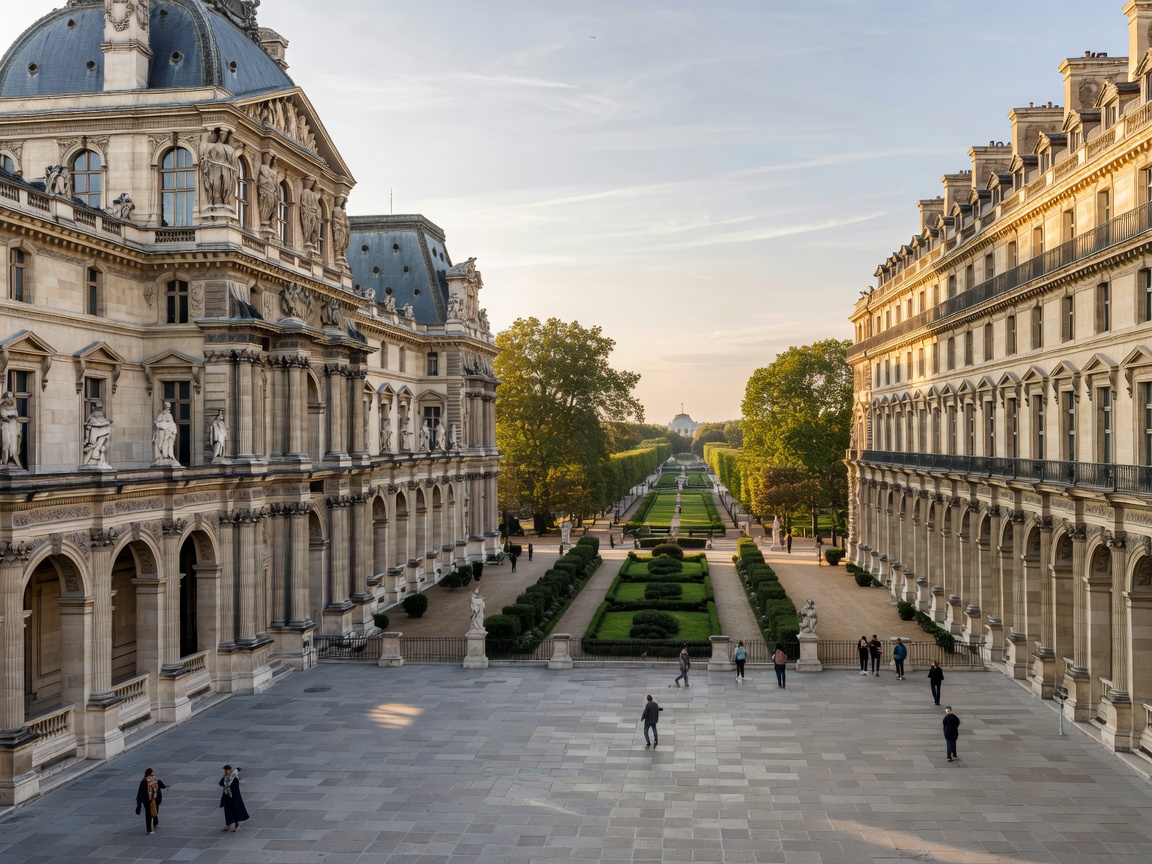
Le Meurice began as a coaching inn for British travellers arriving from Calais and became, by the 1830s, the first true grand hotel in Paris. Its position has never been bettered: a straight run of Rue de Rivoli arcades on one side, the gravel avenues of the Tuileries on the other, and the Louvre five minutes' walk east.
Art, Dalí and Starck
Salvador Dalí stayed here for one month every year for three decades, and the hotel has never stopped trading on the association — with good reason. Philippe Starck's 2007 reinvention of the public rooms is a masterclass in restraint-meets-mischief: the Louis XVI mouldings and Rubelli silks remain untouched, but a Dalí-inspired melted mirror, an upside-down chandelier and a floor-to-ceiling painted canvas by Ara Starck in Le Dalí restaurant introduce a knowing wink.
The Salon Pompadour, modelled after the salons of Versailles, is still used for afternoon tea and private dinners, and is arguably the most beautiful single room in any Paris hotel.
Rooms and suites
160 keys, including 43 suites. Charles Jouffre's refreshed schemes use pale grey and ivory panelling with Empire touches; bathrooms are in white Carrara with mosaic floors. The prize accommodations are the sixth- and seventh-floor suites facing south — the Belle Étoile Royal Suite has a private 360-degree rooftop terrace that takes in the Eiffel Tower, Sacré-Cœur, the Grand Palais and the Panthéon in a single turn.
- Superior Room — 25–30 m², city-side, quiet courtyard aspect.
- Deluxe Room — 30–35 m², Rivoli or Tuileries view.
- Junior Suite — 45–55 m², sitting area, garden outlook.
- Prestige Suite — 70–100 m², separate salon, period furnishings.
- Belle Étoile Royal Suite — 350 m², private rooftop terrace.
Dining
Restaurant le Meurice, under the Alain Ducasse banner, occupies the Salon des Fêtes — a room of mirrors, crystal and Versailles-scale windows — and holds one MICHELIN star. Le Dalí is the all-day room beneath Ara Starck's 140 m² painted ceiling canvas, serving a classic French carte and one of the most sought-after afternoon teas in the 1st arrondissement. Bar 228, panelled in dark oak with a working fireplace, is the most club-like drinking room among the five hotels in this guide.
The pastry counter is the quiet superpower here: Le Meurice's seasonal cakes have a following among Parisians who have never once stayed the night.
Spa and wellness
Valmont Spa spreads across three treatment rooms plus a couples' suite, using the Swiss house's cellular cosmetics line. There is a well-equipped fitness suite open 24 hours, but no swimming pool — a recurring trade-off in the 1st arrondissement, where historic building envelopes rarely allow one.
Key facilities at a glance
| Facility | Detail | Notes |
|---|---|---|
| Restaurants | Restaurant le Meurice Alain Ducasse, Le Dalí | One MICHELIN star |
| Bars | Bar 228 | Live jazz, fireplace, cigar-friendly terrace |
| Spa | Valmont Spa | Three cabins plus couples' suite |
| Pool | None | 24-hour fitness suite |
| Location | Facing Tuileries Garden | Louvre 5 min, Place Vendôme 6 min on foot |
| Art | Ara Starck ceiling, Dalí heritage | Curated art walks on request |
| Parking | Valet | Chargeable |
Pricing and value
Rates open around €1,390 in the January–February window and climb above €2,200 from May to September and across the December holidays. Junior suites begin near €2,400; the Belle Étoile is quoted on request. Of the four Palace houses in this guide, Le Meurice is consistently the most accessible at entry level.
Strengths
- The best museum-district location in Paris
- Tuileries Garden views from many rooms
- Salon Pompadour and Le Dalí are exceptional rooms
- Often the lowest entry rate among the Paris Palaces
- Outstanding pastry and afternoon tea
Considerations
- No swimming pool
- Rue de Rivoli is busy; request a garden or courtyard side
- Smaller spa than the George V or Shangri-La
- Standard rooms modest in size
Our verdict
Le Meurice is the choice for travellers whose Paris is defined by art. You can be inside the Louvre in under ten minutes, cross the Tuileries before breakfast and return to a hotel that treats the eighteenth century as a living idea rather than a museum set.